
Berkeley Projected Versus Actual Release
A projected, tentative, or scheduled date is the administering agency’s current calculation. It can reflect the sentence, jail credit, statutory credits, and other events known at that time. SCDC policy also uses “projected maxout release date” for sentence-calculation records. Maxout generally points to the administered end of the custodial term, but the displayed projection may still change when the underlying calculation changes.
An actual release date records an event that has occurred. For a Hill-Finklea booking, the strongest record pairs release date and time with the disposition or destination. For SCDC, the Released Inmate Search supplies an actual release date and release type. Neither record alone guarantees that the person is free of all custody. “Transfer” can mean the person left one agency for SCDC, another jail, law enforcement, or immigration custody.
Scheduled versus actual: Treat a projected date as an estimate. Use the releasing agency’s dated record to confirm that release or transfer was completed.
Berkeley Release Date by Custody
The first task is classification. Hill-Finklea and SCDC apply different records and rules. The Naval Consolidated Brig Charleston is a military correctional institution with its own command and service channels. A federal civilian case may involve the Bureau of Prisons or a federal court. Searching the wrong system can turn an ordinary no-result into a false conclusion.
| Custody situation | Best date source | Main limit |
|---|---|---|
| Pretrial at Hill-Finklea | Bond or court event plus Booking confirmation | No fixed sentence end date |
| Local jail sentence | Hill-Finklea release or sentence calculation record | No public county calculator was found |
| Current SCDC prisoner | SCDC inquiry, current record, or sentence-calculation record | Projection may change |
| Former SCDC prisoner | SCDC Released Inmate Search | Shows actual state release, not county-jail release |
| Parole candidate | Board result, then SCDC actual release record | A grant is not the door-exit time |
| Military prisoner | Naval Brig Master Control or service liaison | SCDC and BOP are not substitutes |
Find Berkeley Projected Release Dates
For a state prisoner, start with SCDC rather than the Berkeley jail roster. The ordinary SCDC Inmate Search is a current-custody tool. Its official disclaimer says data reflects people incarcerated as of the prior midnight and excludes released offenders, county detention sentences, and people on community supervision. SCDC’s automated VINE inquiry at 1-866-727-2846 can locate a person by name, SID, or SCDC number and provide current location and projected dates.
- Confirm whether the person is at Hill-Finklea, in SCDC, or held by another system.
- For current SCDC custody, search with the best identifier and note the access date.
- If the public result does not make the projection clear, use the SCDC telephone inquiry.
- For a local sentence, ask Hill-Finklea for its recorded maxout calculation and jail credit.
- For a person already released from SCDC, use the released search for the actual date and type.
- Pair any parole event or court order with agency confirmation of completed release.
Once a person has left state prison, the SCDC Released Inmate Search is the correct state record. It searches by release-date interval and county rather than by name. Select Berkeley, review the resulting names, and try all locations if the expected row is absent. The Berkeley filter does not mean the person was released from Hill-Finklea.
SCDC Berkeley Release Calculator
SCDC publishes an explanatory release-date calculator. It can help readers recognize sentence and credit concepts, but its estimate does not override the Department’s official sentence administration.
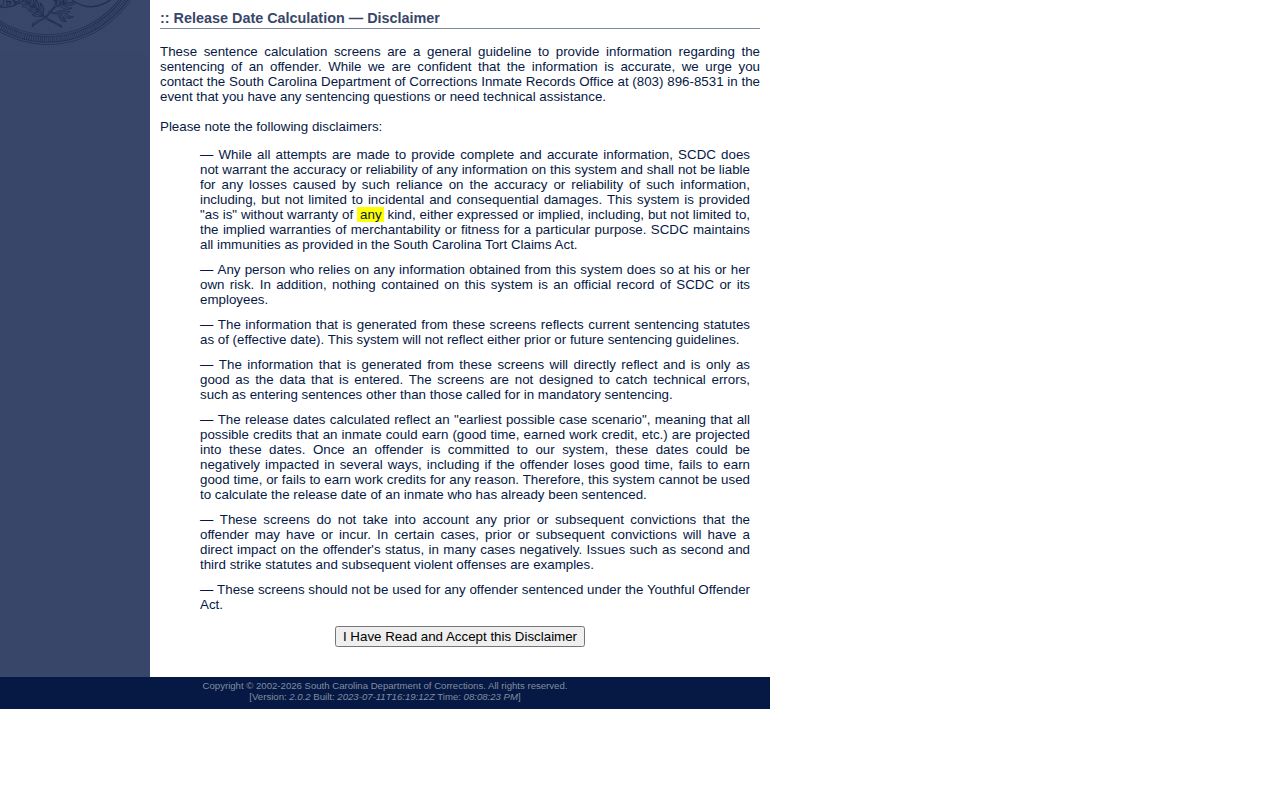
The calculator’s inputs and warnings reinforce the central point: an individual’s official date depends on the record SCDC maintains, not independent arithmetic based on a court sentence alone.
For a fuller official record, request the existing release summary, sentence-calculation sheet, projected or maxout history, and release type from SCDC FOIA. The Office of General Counsel accepts requests at FOIA@doc.sc.gov or by mail at PO Box 21787, 4444 Broad River Road, Columbia, SC 29221-1787, subject to lawful exemptions.
South Carolina Release Credit Rules
South Carolina Code Title 24, Chapter 13 establishes several distinct credit rules. They cannot be compressed into one statewide formula. Under Section 24-13-210, an eligible SCDC prisoner generally receives twenty days of good-conduct credit for each month served. A person convicted of a statutory no-parole offense generally receives three days per month, subject to exclusions and the truth-in-sentencing floor. A qualifying locally sentenced detention-facility inmate receives one day for every two days served.
Good-conduct credit rewards compliance with institutional rules and can be forfeited for misconduct. Work and education credits under Section 24-13-230 are a separate category. Their effect differs from good time, including how they may apply to conditional or unconditional release criteria. SCDC explains that good time can help establish sentence expiration but does not establish parole eligibility in the same manner.
Section 24-13-150 sets an 85-percent floor for the statutory no-parole category, subject to its terms and exclusions. It does not mean every South Carolina prisoner must serve 85 percent. For covered sentences, credits do not reduce confinement below the statutory floor. Offense classification and sentence details therefore matter before any percentage can be applied.
The official sentence-credit provisions show those separate formulas and the 85-percent rule.
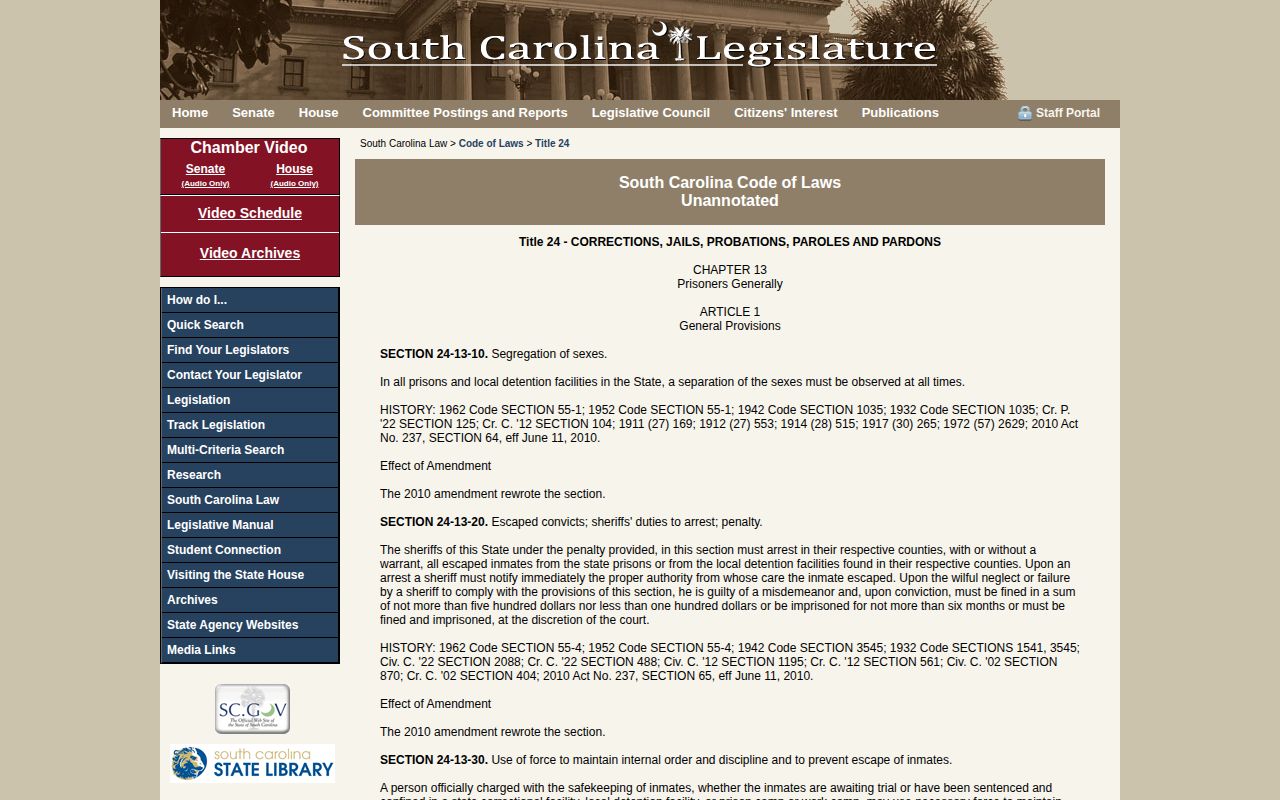
The statute supports asking the administering agency for its calculation rather than producing a private estimate for a Berkeley County inmate.
Berkeley Jail Credit Formula
The local formula is a distinctive part of a Hill-Finklea sentence. Qualifying conduct can earn one good-conduct day for every two days served under Section 24-13-210(C). Hill-Finklea does not publish an individual release calculator or a county policy that shows how each input is posted. That gap makes the jail’s recorded calculation the proper source.
Ask for the sentence start, credited jail time, the recorded maxout date, credits awarded or forfeited, and any hold affecting discharge. Do not assume the booking date equals the sentence start. A court may award prior confinement credit, modify a sentence, or set concurrent or consecutive terms. “Concurrent” means terms run together; “consecutive” means one follows another. Those choices can produce very different dates.
Local processing is also separate from sentence math. Hill-Finklea states that physical release can take one to four hours after all required documents arrive. Thus a computed end date, a signed court order, and the actual exit time may be three distinct facts.
Why Berkeley Release Dates Change
A projection changes when the facts used in the agency calculation change. Some events move the end of custody. Others change eligibility for a conditional release without changing the maximum sentence date in the same way.
| Factor | Possible effect | Where to confirm |
|---|---|---|
| Jail credit or corrected start | Moves the administered sentence calculation | Court order and jail or SCDC record |
| Concurrent or consecutive sentence | Changes how multiple terms overlap | Sentencing order and calculation sheet |
| Credit award or restoration | May advance an eligible projected end | Administering agency record |
| Discipline and forfeiture | May move a projected date later | Credit and disciplinary record |
| Detainer or hold | May cause transfer or continued custody | Holding and receiving agencies |
| Appeal or new court order | May alter the sentence basis | Court docket and agency calculation |
| Parole decision | Can permit conditional release if completed | Board result and SCDC release record |
A detainer is a request or notice tied to another authority’s custody interest. It can mean a person leaves SCDC or Hill-Finklea through transfer, not community release. Always ask for the receiving agency when a disposition is unclear.
Berkeley Parole Is Not Release
Parole is conditional release from an eligible prison sentence under Board authority. A hearing date merely schedules review. A grant means the Board approved parole subject to applicable conditions and planning. Neither one establishes the physical exit time. Confirm completion through SCDC’s actual release data and post-release supervision through SCDPPPS.
Title 24, Chapter 21 supplies general parole provisions. Section 24-21-610 ordinarily uses one-third of a term of thirty years or less, or ten years for life or a term over thirty years, while also carrying violent-crime minimums, exclusions, and other statutory rules. Good-behavior deductions do not compute parole eligibility in the same way as earned-work credits. The Board’s authority to consider a case is never a guarantee of release.
For practical confirmation, use the Board’s person-specific result, then look for an SCDC released-list row and an SCDPPPS or VINE supervision record. Those three records answer different questions: the decision, the completed state-custody event, and the community-supervision status.
Berkeley Pretrial Release Timing
A pretrial detainee has no computed sentence end date. The next custody change may depend on a bond condition, payment or recognizance, dismissal, a new court order, or a transfer. A docket entry can show that a judge authorized release, but it does not establish when Hill-Finklea received complete documents and finished processing.
Check the Berkeley court record for the legal event, then confirm the physical status with Booking. Hill-Finklea’s stated processing range begins only after all required documentation arrives. Another agency’s hold can prevent community release even when the local case permits it. Ask whether the person left the jail, when the booking ended, and whether the disposition names a receiving agency. Those questions are more accurate than asking staff to calculate a projected date that does not exist for pretrial custody.
Confirm Berkeley Actual Release
For Hill-Finklea, call Booking at 843-719-4876 and request the existing booking or release sheet when durable proof is needed. Ask for release date and time, disposition, and destination. A court docket can explain a bond, dismissal, sentence, or release order, but jail processing confirms when that booking episode actually ended.
For SCDC, compare the current-only locator with the released search. For a future status change, the VINELink Check explains alerts and the separate SCDC registration path. VINE data can lag. Preserve the alert time and verify the event with SCDC. A projected date should never be turned into an exact pickup time or a promise that no transfer will occur.
Note: Label every projection with its source and access date because later credits, holds, orders, or corrections may change it.
Search Public Records
Sponsored Results